Monday, 22 June 2015

Sensing The Surface - Marlene Dumas & Sam Mitchell

Marlene Dumas, Amy - Blue, 2011, oil on canvas, 40 x 30 cm, National Portrait Gallery, London. Purchased 2011. copyright Marlene Dumas, photo Peter Cox

Amy, Blue by Marlene Dumas
Oil on canvas, 40 x 30 cm
National Portrait Gallery, 2011


Marlene Dumas, Naomi, 1995, oil on canvas, 130 x 110 cm., collection De Heus-Zomer, copyright Marlene Dumas, photo Peter Cox
Naomi by Marlene Dumas
Oil on canvas, 130 x 110 cm
Collection De Heus-Zomer
1995


Marlene Dumas, The Wall, 2009, oil on linen, 180 x 300 cm., collection Gayle and Paul Stoffel, copyright Marlene Dumas, photo Peter Cox
The Wall by Marlene Dumas
Oil on linen, 180 x 300 cm


I find Marlene Dumas style of art emotive and haunting, yet very intriguing. 
Her portrait paintings make me feel that behind these paintings, lays unhappiness. Giving no facial expression leaves me curious about why Marlene communicates that question with her viewers or me. I love that there is mystery here, a story that is waiting to be told. I think she creates a lot of her portraits using oil paint on a canvas surface,


Bloom by Sam Mitchell
Acrylic on perspex, 40 x 30 cm
2013


Tiffany by Sam Mitchell
Acrylic on perspex, 77 x 47 cm
2013


Cloak without dagger by Sam Mitchell
Watercolour on paper, 14.8 x 21 cm
2013


I personally like Sam Mitchell's style of art because it is very unique and also attentive. Portraying child innocence and irreverence that is as unsettling and humorous as it is naive and authoritative. The amount of detail she puts into her work is amazing! I feel that her paintings say a whole lot more than the titles she gives her paintings. Creating majority of her paintings on a perspex surface which is a solid transparent plastic sometimes called acrylic glass made of polymethyl methacrylate.


Manipulating The Image - Printmaking (Blog 10)


Printmaking

A form of art that involves transferring ink to paper, making many copies of the same artwork. Each individual copy is called a "print." A set of print's are called "an edition" and a signed and numbered set of prints is called "a limited edition." Printmaking originated in China around 105 C.E. after paper was invented.


Early Uses Of Printmaking.


  • Saints Card 
  • Paper Money
  • Tiles
  • Tarot Cards
  • Books (After the invention of paper.)
  • Playing Cards


The Diamond Sutra
The oldest known dated printed book in the world.
Used as a teaching of Buddhism.


Three Printmaking Techniques


Relief - Where ink is applied to the original surface of the matrix. Relief techniques include woodcut or woodblock as the Asian forms are usually known, wood engraving, lino cut and metal cut.

Planographic - Where the matrix retains its original surface, but is specially prepared and/or inked to allow for the transfer of the image. Planographic includes lithography, monotyping and digital techniques.

Stencil - Where ink or paint is pressed through a prepared screen, including screen-printing and pochoir.


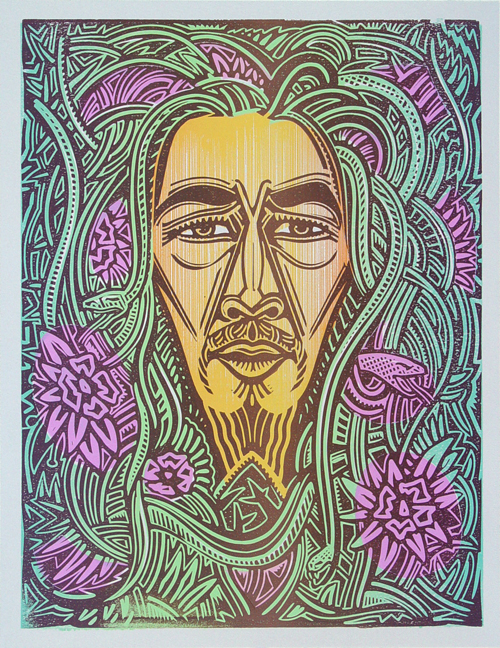
Bob Marley II (1999) by Stephen Alcorn
 Hand printed on Acid Free paper,  17 x 13 in. image, 23 x 17-1/2 in.
(5 blocks, dark over light)
Relief-block prints.


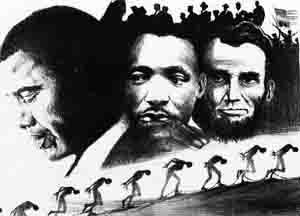
Change by Charles Criner
Created on a 1830s (19th century) star-wheel stone lithography press.
Portrays the history of three historic Americans also the African Americans and the great change that has occurred in USA. Beginning with slavery, the civil rights movement and the Obama presidency. (Abraham Lincoln, Martin Luther King, Barack Obama.)
Lithography/Planographic


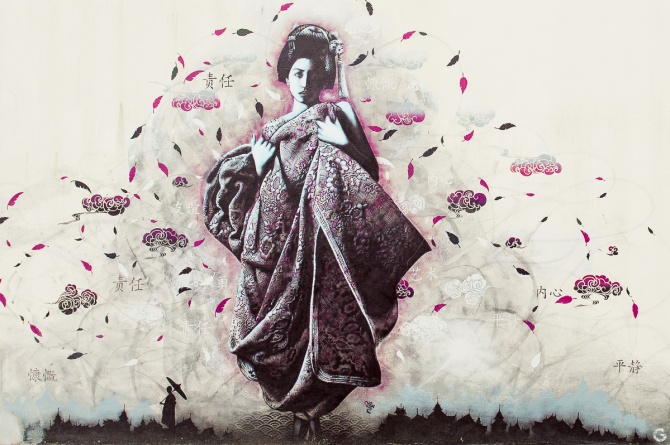
Ever she comes on a mountain breeze by Fin DAC
Apart of the Crimes of Minds project located in Brest, France.
Stencil Print-making.

Wednesday, 3 June 2015

Manipulating The Image - Art Hero/Frida Kahlo (Blog 9)

"Frida Kahlo"


"I paint myself because I am so often alone and because I am the subject I know best." Born Magadalena Carmen Frieda Kahlo y Calderon on July 6th in 1907, a self taught Mexican painter mostly famous for her self portraits. Her work was sometimes characterized as naive or folk art due to the bright colours, dramatic symbolism and primitive style of the Mexican culture and Amerindian culture traditions that played an important role in her work. Rejecting the surrealist label, Frida believed her work reflected more on her reality than her dreams. "Feet, what do I need you for when I have wings to fly."  Suffering from long life health problems mostly caused by a a traffic incident she was involved in as a teenager, this was told through majority of her paintings as they related to her tough experiences with physical and psychological suffering.


Abandoning her medicine studies after the accident, Frida than began to paint to occupy herself over a three month recovery. Later heavily influenced by Mexico's most famous artist Diego Rivera that she always admired after approaching him at the the Public Ministry of Education with four of her paintings and asked if he found her gifted. Recognizing her talent, Frida's work impressed Rivera and he replied "You have got talent." Then later giving her many insights about her work to encourage her artistic development with positive and encouraging comments that strengthened Frida to pursue a career as an artist. "I never painted my dreams, I painted my own reality."


Falling very ill during the 1950s due to the amputation of her right lower leg caused by gangrene then bronchopneumonia later occurring followed by anxiety attacks that led her to increasing her morphine consumption. Passing away on July 13th in 1954, Frida's work is celebrated in Mexico as emblematic of national and indigenous tradition and by feminists for its uncompromising depiction of the female experience and form. Since 1948, her former home in Coyoacan that holds and displays her ashes after being cremated that now rest in a pre-Columbian urn is now a well maintained museum housing a number of artworks and numerous mementos and artifacts from her personal life.


                                   "I hope that leaving is joyful; and I hope never to return."
                                                                     - Frida Kahlo

Manipulating The Image - Posters And Art Heroes (Blog 8)

"KING KONG"

The King Kong movie poster was originally created in 1933 by a Chinese born American actor, Keye Luke. I believe the King Kong poster was used to help promote the movie, it was created to help sell tickets, to get customers from the public rolling in to view the classic monster/adventure film directed and produced by Merian C. Cooper and Ernest B. Schoedsack.


"JOIN, OR DIE.''

A woodcut showing a snake cut onto eighths with each segment labelled with the initials of one of the thirteen American colonies or region. This, "Join, Or Die, a well known political cartoon created by Benjamin Franklin in 1754. From doing my research about this piece I believe this cartoon was created and used to communicate with the American colonies that they must unite if they wish to successfully fight the British for independence.


"GUERRILLERO HEROICO"

A worldwide symbol of revolution and rebellion in the 20th century, the Guerrillero Heroico is one of the most famous posters in the world. A portrait of Che Guevara, a Argentine Marxist revolutionary physician, author, guerilla leader, diplomat, and military theorist. A major figure of the Cuban revolution. The photograph was originally taken by a Cuban photographer, Alberto Diaz Gutierrez or also known as Alberto Korda in 1960 at a memorial service for the victims of the La Courtine explosion that happened in Havana, Cuba. Later the image was created and reproduced to be used as model for a colour poster by an Irish painter Jimi Fitzpatrick in 1968.

I believe Fitzpatrick reproduced this photograph into a poster because he felt the need that the image had to come out or Che Guevara would not be commemorated otherwise, he would go to where heroes go, which is usually into anonymity.